climatechange

climatechange

What does ‘temporary’ mean in politics? Zane Lightbourne steps in as ‘temporary’ enviroment minister after Vaughn Miller’s death

Zane Lightbourne has been appointed the ‘temporary’ Minister of the Environment and Natural Resources, according to a statement from the Office of the Prime Minister.

The announcement comes about two months since the sudden death of Minister Vaughn Miller, who held the portfolio up until his passing.

Lightbourne, who previously served as Minister of State in the Ministry of the Environment, will now oversee the ministry’s operations, but only in a “temporary” capacity, the press statement noted.

No timeline has been given for how long he will serve in the “temporary” role or whether the position could become permanent.

It could mean he continues the work left by Miller until the general election, or that he is given the post to ensure that the ministry continues to function without disruption while the Prime Minister Davis decides on a permanent replacement.

The Ministry of the Environment and Natural Resources is important since it handles trending and global issues like climate change, waste management, and conservation.

Lightbourne’s appointment means he will carry out the duties and decisions of a full minister until a formal change is made.

The Prime Minister’s Office expressed confidence in Lightbourne’s ability to maintain the ministry’s work and advance its agenda.

Miller died September 28, leaving the post void until now. Lightbourne now steps into that position and is tasked with continuing Miller’s work.

After Vaughn Miller, who leads the Environment and Natural Resources Ministry now?

The Bahamas is mourning the sudden death of Cabinet Minister Vaughn Miller. But as tributes pour in, another question emerges: who takes charge of the country’s environmental agenda in his absence?

Miller, who served as Minister of the Environment and Natural Resources, carried responsibility for protection and conservation of the environment, international treaties and agreements relating to the environment, land use, permitting, climate resilience, coal and aragonite mining, oil and natural gas, reefs and blue holes, wild animal and bird protection, public sanitation— all areas critical to the Bahamas’ future. His passing creates a policy vacuum in a ministry that faces constant international and domestic pressure.

Why does it matter?

Miller’s role as Environment Minister meant he was likely directly engaged in climate negotiations, environmental allocations, international funding for conservation, carbon credits, and hurricane resilience. His death may disrupt continuity in those negotiations or temporarily weaken the Bahamas’ leverage.

The Bahamas has made commitments on climate change financing and environmental regulation. It has pledged tighter oversight of development projects, many of which depend on ministry approvals. Without clear leadership, ongoing projects could slow down, and international partners may question continuity.

Any ongoing or upcoming environmental initiatives, regulatory reforms, or international commitments Miller backed may stall, and projects in mid-completion could face delays or review.

The big picture

The loss of a sitting minister is rare, but it raises questions about whether succession plans exist to ensure stability when the unexpected happens.

When Minister of Social Services, Information and Broadcasting Obie Wilchcombe unexpectedly died on September 25, 2023, within a few days, Davis became acting Minister of Social Services, Information and Broadcasting until Myles Laroda assumed the official position on January 2, 2024.

State of play

Prime Minister Philip Davis has not yet assigned an acting minister. The absence leaves both environmental advocates and developers guessing what comes next.

Davis will need to assign a new minister, temporarily or permanently.

The bottom line

It remains to be seen if an acting minister will be named within days, if Miller’s files continue or are shelved, and whether or not his death triggers a wider Cabinet reshuffle before an upcoming general election.

What Can Davis Accomplish at COP27 as Inflation and Energy Prices Surge Around the World?

Prime Minister Philip Davis carried a contingent of 70 people from the Bahamas to attend COP27 in Sharm El Sheikh, Egypt, to call on developed countries to pay for the effects of climate change on small island nations like the Bahamas.

Davis like other leaders of small island nations contend that the release of greenhouse gases like carbon dioxide has increased the likelihood of hurricanes which have worsened over the past few years, and the country’s debt is tied to the responses to natural disasters.

PM Davis is shown in Egypt. Photo credit: Office of the Prime Minister

Last year, at COP26 in Glasgow, Scotland, chief “polluters” like the United States, China, India, Russia, Japan and Germany promised to reduce emissions of greenhouse gases by 1.5 degrees Celsius. But only a few countries that signed on to the Paris climate agreement, have worked toward the target goal.

Reports say carbon dioxide levels in the atmosphere that were released from developed countries this year reached 421 parts per million, the highest in history. In fact, the planet just recorded one of the hottest summers.

Many countries have experienced rising floods, heat waves, storms, and droughts which are believed to be worsened by rising temperatures, which experts say are the repercussions of climate change.

However, following Russia’s invasion of Ukraine, the world changed its focus to inflation, rising energy prices, conflict, food shortages and supply chain issues which would likely prevent any other focus on the goal of reducing greenhouse gas emissions.

The fuel shortages spurred by the conflict, are pushing countries toward mining and drilling for fossil fuels. Germany has since restarted coal power plants.  And world leaders are worried about rising prices.

Preventing temperatures from exceeding 1.5 degrees seems out of reach and it’s likely the developed countries will ignore the pleas of Davis, Mia Mottley and other leaders of small island nations in compensating for climate change losses.

In Pictures: Hurricane Ian Rips Florida, Uproots Homes. Hundreds May Be Dead

Floridians along the west coast woke up on Thursday morning to devastation as Hurricane Ian moves over the state.The ferocious storm dumped rain and brought wind gusts that pushed over homes, uprooted trees, and may have killed hundreds of people.Two million people are without power and many are without water.Rescue workers are searching for people trapped in their homes.

Florida Governor Ron Desantis described it as historic. “We’ve never seen a flood event like this,” he said. “It is one of the top five hurricanes to ever hit the Florida peninsula.”

President Biden has since declared it a disaster, approving disaster funding to get the state to a sense of normalcy. He added that though not official, many people are feared dead. “This could be the deadliest storm in Florida history. The numbers we have are still unclear, but we’re hearing early reports of what may be a substantial loss of life.”

Ian made landfall on Wednesday as a category 4 hurricane. It has since weakened to a tropical storm as it barrels up north but is expected to strengthen as it moves over the Atlantic Ocean later on Thursday.

Orlando has since declared a flash flood emergency.


Photo credit: Getty, ABC News

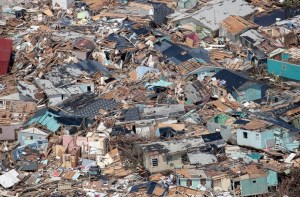
Scenes From Hurricane Dorian: Remembering the Killer Storm 3 Years Later

Today marks the third anniversary of the passage of Hurricane Dorian over the Bahamas.

On September 1, 2019, the monstrous storm caused widespread devastation in Grand Bahama and Abaco and killed many residents on these islands.

Many people remain missing.

Here is a look back at this emotional period in Bahamian history as many Bahamians and Haitian migrants still struggle to regain a normal life some three years later.


COP26: Davis and Mottley Tell Rich Countries to Deliver on Climate Change Promises

Small island nations like the Bahamas are “out of time” in battling climate change and Prime Minister Philip Davis urged rich countries to take urgent action.

Speaking at the climate change summit, COP26, in Glasgow, Scotland, Davis reminded developed countries that the Bahamas, like other island nations, is threatened with hurricanes that are increasing with intensity and frequency.

He reminded attendants of Hurricane Dorian’s devastating effect on the Bahamas, requesting funding and technology to rebuild “resiliently.”

“Our hurricanes are your fires and floods. Our hurricanes are your landslides and droughts.

“Please do what is needed, not what you can get away with. Turn promises and agreements into action,” he said.

“Don’t hide behind buzz words and hazy promises.

“Don’t let the failures of the past limit our ambitions for the present. Failure today can lead to destruction tomorrow.”

G20 leaders met in Rome lastweek to discuss climate change and agreed that 1.5 degrees celsius will be their target by 2030.

On Monday, Prime Minister of Barbados Mia Mottley urged delegates that a 2-degree Celsius rise in global temperature would be a “death sentence” for island and coastal countries.

“We do not want that dreaded death sentence, and we have come here today to say, ‘Try harder.’ ”

Mottley warned that failure to provide enough funding to small island nations on the frontlines of climate change is “measured in lives and livelihoods.”

“This is immoral, and it is unjust,” she said.

Countries like China, the United States of America, India, and Germany are the biggest contributors of greenhouse gases, accounting for 80% of gas emissions.


Davis to Hold World Leaders Accountable for Climate Change Threat to the Bahamas

Prime Minister Philip Davis said he will ensure developed countries pay for the calamitous effect of climate change on the Bahamas.

After his arrival on Sunday, Davis said that the country’s voice will be heard at the COP26 Summit in Glasgow, Scotland, in what has been called a make-or-break opportunity to save the planet.

“I want them to see what yesterday was for us and what tomorrow could be like for them, and to motivate them to do more for Small Island Developing States like us, because the cost to adapt and to mitigate in respect to the consequence of climate change is humongous and beyond our means in many, many respects.

“We want to be able to sensitize them to that and we need our voices heard to ensure that they pay for what has happened to small island states like us.

“We are not going to leave here without having a clear understanding of what we will get for what they would have done to us.”

Why it matters

Small Island States like the Bahamas, have suffered due to global warming. The intensity of storms throughout the years, like Hurricane Dorian in 2019, has been worsened by global warming, according to experts.

Scientists say storms draw their energy from ocean heat and more than 90 percent of the heat is trapped by greenhouse gas emissions, stored in the ocean. Storms then intensify quickly and become powerful.

The big picture

Countries like China, the United States of America, India and Germany are the biggest contributors of greenhouse gases, accounting for 80% of gas emissions.

World leaders met in Rome over the weekend for the G20 meeting with a goal to limit global warming to 1.5 degrees Celsius. However, no date was set.

State of Play

US Congress is wrangling over how to finance its climate change pledge and whether or not the US can regulate greenhouse gas emissions.