claytonfernander

claytonfernander

How did we get here? Clayton Fernander’s new appointment after a rocky exit

Just about eleven months after stepping down as Commissioner of Police, Clayton Fernander has resurfaced as Consul General to Toronto, Canada.

His appointment comes on the heels of a turbulent period for the Royal Bahamas Police Force, marked by allegations that officers under his command used their positions to smuggle contraband into the United States.

Though Fernander was not personally implicated in the wrongdoing, his sudden resignation on December 4, 2024, raised questions. Now, his diplomatic posting has many asking:

How did we get here?
Consul General Clayton Fernander arrived in Canada on the 6th of November and met with team members at the Consulate Office on 7th November. His official start date in office is Monday, 10th November 2025.

November 26, 2024: A force under scrutiny

The RBPF faced one of its most serious public scandals when U.S. authorities reportedly uncovered a network involving Bahamian officers–two officers of the Royal Bahamas Police Force and one officer of the Royal Bahamas Defence Force, accused of using their position to facilitate contraband smuggling operations into the US.

December 4, 2024: Clayton Fernander resigns

Fernander was never named in the allegations, but the issue cast such a shadow over his leadership that calls for accountability grew louder. He resigned as Commissioner, with Prime Minister Philip Davis announcing in the House of Assembly that he accepted the resignation, saying the police force “needs change.”

November 3, 2025: From resignation to redeployment

About eleven months later, the government announced Fernander’s appointment as Consul General in Toronto, one of the country’s key diplomatic posts, with a large Bahamian diaspora.

This has caught many by surprise. Some argue that the appointment suggests a “soft landing” for a top official exiting under pressure, while supporters say Fernander’s experience and international training with Canadian contacts make him fit for the role.

What does a Consul General do?

The Consul General represents the Bahamas abroad, assisting Bahamian citizens, promoting the country and supporting diplomatic missions.

The post comes with perks: official residence and a good salary.

These appointments are made directly by the Cabinet, often reflecting the government’s confidence in the individual’s loyalty and leadership skills.

Why this matters

Fernander’s return to public office in a diplomatic role defines about how accountability works in the Bahamas.

Some may ask, ‘Why do some officials reappear in powerful posts so soon after controversy? And ‘Is this a reflection of how political loyalty outweighs public perception?’

Fernander’s appointment is a familiar pattern in Bahamian politics, where resignation amidst a scandal is without accountability, but is followed by reward through a form of redeployment.

The bottom line

Fernander’s move from the country’s top cop to the country’s representative in Toronto is a case study in how the system in the Bahamas deals with power and political loyalty.

When will Shanta Knowles become official police chief?

Though named Clayton Fernander’s successor, Shanta Knowles has yet to be officially appointed police commissioner.

Knowles was Fernander’s pick when he surprisingly resigned last week Wednesday, amidst a backdrop of a high-profile United States indictment implicating members of the police in corruption, with other allegations of a chief superintendent colluding with criminals.

“Shanta Knowles, who has oversight of the northern district as you know and is stationed in Grand Bahama, is winding up her affairs there and, of course, as the handover ceremony is planned, an announcement of the date will be made in the days ahead,” Acting Press Secretary Keishla Adderley said at a press conference at the Office of the Prime Minister.

Before being named, Knowles was the Assistant Commissioner Shanta Knowles, overseeing the northern district and stationed in Grand Bahama.

When she becomes Commissioner, she will be the first woman to prepare for a handover ceremony, signaling a new chapter for the RBPF.

The exact date has not yet been announced.

It remains to be seen the decisive steps that the government will take to ensure a smooth transition and how Knowles will address the systemic and outstanding issues plaguing the organization.

How the Public Is Responding to the Death of a 4-Year-Old Killed in Hail of Bullets

Following the killing of a four-year-old on Tuesday night, some members of the public are calling for the ultimate punishment for convicts accused of killing children.

Four-year-old Kenton Seymour with his father.

Reports are that Kenton Seymour Jr was in a vehicle with his parents on West and Fleming Streets around 10 pm, when gunmen reportedly chased and fired shots at a man, instead shooting into the windshield of a car, killing the young boy who was sitting on his mother’s lap.

The child was rushed to the hospital but died a short time later.


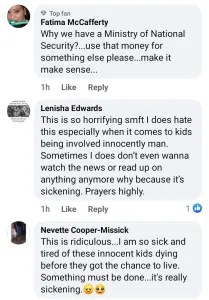
Renewed calls for capital punishment were echoed on social media.

“Our biggest problem is the Privy Council. They never deem anything ‘the worst of the worst’. Our own judicial system here has been failing us,” Taylor Mara said.

Kenton is seen with his uncle.

Brittonee Newry asked, “How many kids have to die for the nation to get serious? Does the violence have to hit the home of some elites for the ax to come down on the heads of these murderers?”

Alexandra Major lamented, “This is unacceptable. Something must be done about all these killings and guns.”

Senator Maxine Seymour joined in the chorus, responding to a post by Helen Johnson who asked, “How many more innocent children’s lives will be taken by these ruthless thugs? Members of Parliament and Senators, please make changes to the law.”

Seymour said, ” You’re quite right. Anyone who harms a child in any way, not just death, deserves the ultimate punishment.”

Though the death penalty remains on law books, it has not been carried out since January 2000.

The Bahamas’ highest court based in London, The Privy Council, ruled in 2011 that the death penalty law should only apply to murders deemed the “worst of the worst”–a person who kills a police or defence force officer, a member of the Departments of Customs or Immigration, judiciary or prison services would be eligible for a death sentence; a person convicted of murdering someone during a rape, robbery, kidnapping or during an act of terrorism.

Kenton’s murder was one of three shooting incidents yesterday.

Police said they have seen an uptick in homicide cases. 82 murders have been recorded for the year.

Police said they have the intended target in custody and are searching for the suspects in this latest homicide.


Fernander Questions Rolle’s Motive Before Exit: ‘Why Now?’

Newly appointed Commissioner of Police Clayton Fernander openly questioned Former Commissioner Paul Rolle’s motive to express his displeasure with the Minnis administration’s decision to place senior officers on leave.

“Why wait until now to highlight that to the members of the public? Fernander who was one of the senior officers sidelined, asked as he appeared as a guest on Global Paradigm Shift with Michelle Malcolm.

Before his retirement, Rolle made headlines last week when he revealed that the Minnis administration pressured him to sideline senior police officers known as ‘PLP operatives’ in 2019 and assign them to various ministries.

Malcolm suggested that perhaps Rolle, who handed the reins of power to Fernander on Tuesday, thought that it was safer to reveal it before his exit

“I guess he figure, he going now, they can’t do him nothing,” Malcolm said.

Fernander retorted, “But why wait now? Why now?”

Malcolm then suggested that Rolle could have “shame them (Minnis administration) then and come out then and say it.” To which Fernander responded, “Exactly.”

Rolle shockingly revealed that the political pressure nearly caused him to resign as Commissioner of Police.

“I think the relationship was getting a little tense because of my stance,” he told a daily.

“I refused to do it. I said, ‘You give me something in writing and I will carry out your instructions. Without that, I’m not going to do it.’”

The senior officers were eventually returned to their posts when the Progressive Liberal Party won the General Election in 2021, one of whom, Leamond Deleveaux was promoted to Deputy Commissioner on Wednesday.

5 Things to Know About the New Commissioner of Police

Clayton Fernander was sworn in on Tuesday as the country’s 9th Commissioner of Police, replacing outgoing Commissioner Paul Rolle.

Rolle resigned from the police force with nearly forty years of service and handed the reins to Fernander who was appointed Deputy Commissioner in December 2021 after the Progressive Liberal Party was sworn in as the new government.

Leamond Deleveaux who was sent on leave with Fernander was appointed Deputy Commissioner.

Fernander’s appointment comes at a time when the country is dealing with troubling murder rates which are hitting unprecedented numbers. Seventy-four murders have been recorded so far for the year.


Here’s what to know about Fernander:

  1. While serving on the police force, Fernander was known for his connection to the Progressive Liberal Party and may have suffered for it when the Free National Movement was elected in 2017. He and three other officers holding top posts were eventually sent on leave in 2019 which many argue was a political move.
  2. Fernander was reappointed when the Progressive Liberal Party became the new government and became Deputy Commissioner.
  3. Prime Minister Philip Davis said Fernander is “the right man for the job.”
  4. He joined the police force in 1982, serving in traffic and the criminal investigation department, and once headed the Central Detective Unit before his promotion to Assistant Commissioner
  5. He was shot multiple times at his home, in an attempted armed robbery in 2013, sustaining injuries to his arm and upper body. “…I can recall and reflect back when I was a victim where I had arrived home and individuals were there waiting for me and held [me] up and robbed me, and [shot me] during that time, so it’s never a good thing look down the barrel of a firearm.”

What the Retirement of Police Commissioner Means for the Bahamas

It was a surprising and spontaneous announcement.

Commissioner of Police Paul Rolle will retire from the police force this year after nearly 40 years of service.

His exit comes after nearly two years as the police chief.

Clayton Fernander was appointed deputy commissioner in December, after the Progressive Liberal Party was elected. Many believe he will be the next Commissioner of Police.

The news has stirred speculation that Deputy Commissioner Clayton Fernander will succeed him at the end of his term. Though few expected his tenure to expire so soon after reassuring the public of an extended stay on the force, many anticipated his end was sooner since a new government was elected.

Here’s what you need to know:

Why is he retiring now?

Paul Rolle has been the Commissioner since 2020. He took on the role at the beginning of the COVID-19 pandemic, helping to navigate the pandemic and enforce the country’s COVID-19 measures.

While addressing reporters outside of a charitable event hosted by the RBPF, Rolle was asked about his tenure and unable to navigate the conversation, he blurted, “I met with the team this morning and I could say to you that I do intend to make my exit from the police force at some point. I will have 40 years and so I’m looking down the 40-year mark and I’ll make a decision on that in due course.”

He is four years away from retirement age but has already spent 40 years on the police force. An extension can be granted if the new government, the Progressive Liberal Party, really wants to.

Though governments dismiss that the appointment of commissioners is non-political, Bahamian history has shown that each elected government appoints police chiefs who align with their party’s philosophy and hasten the removal of those who do not.

In December, three months after the new government was elected, Rolle backed by Prime Minister Philip Davis sought to dismiss claims he would be replaced and said he had no plans to leave the Force. “I’m 56 and the Police Act says you could work until you’re 60, and the Pension Act says 65.”

What is Paul Rolle’s relationship with the present government?

Anthony Ferguson was succeeded by Paul Rolle.

Rolle was appointed Commissioner by the Free National Movement after the retirement of Anthony Ferguson.

During his tenure, he has faced public criticism for his management of the COVID19 rules which many deemed restrictive and unfair. Some street vendors like the Coconut boys were hauled before the courts for violating COVID-19 measures. It cast a negative light on the force at a time when many Bahamians were struggling to cope financially.

In addition, the killing of 6 men at once after their release from police custody and he labelling them as idiots, has caused mounting criticism.

When a new government was elected in September, the Progressive Liberal Party brought back senior officers sent on early retirement by the FNM, one being Fernander who the PLP later appointed deputy to Rolle.

What does his retirement mean for crime?

Rolle’s announcement comes at a sensitive time for the Bahamas when crime is surging as the country reopens its economy. Multiple murders a day and brazen shootings are on the rise and calls for a new approach to policing are becoming louder.

Rolle came up through the ranks of the police force with little street experience and more administrative experience. The opposite is true for Fernander who once a victim of crime when he escaped a near death experience during a robbery. He has risen within the ranks with the knowledge and experience necessary to deal with gangs and violent crimes.


Photo credit: Eye Witness News