
Created by cherika johnson using the free <a href="https://amuselabs.com/games/word-search/" target="_blank" style="color: #666666; text-decoration: underline;">word puzzle builder</a> from Amuse Labs

CSJ Report—Understand Bahamian News
Smart News, Clear Context

In light of the recent events surrounding Chief Superintendent Elvis Curtis, and Chief Petty Officer Darren Roker, the conversation about accountability and leadership within law enforcement agencies has been reignited.
The indictment of Curtis, Roker along with Sergeant Prince Symonette, for their alleged involvement in a cocaine importation conspiracy in the United States, is a stark reminder of the weaknesses that exist within the institutions tasked with protecting the country.
The role of a chief superintendent or a chief petty officer is crucial in setting the standard for integrity and ethical conduct within law enforcement. When an individual in such a position is accused of crimes that directly undermine the organization, it casts a shadow over the entire organization they represent.
It is a breach of public trust that cannot be overlooked.
The Royal Bahamas Police Force is already plagued with corruption allegations following leaked audio recordings released on social media involving another Chief Superintendent Michael Johnson who is in charge of the Criminal Investigations Department (CID). The public is still awaiting the results of the investigation after he was placed on leave for involvement in the matter.
Leader of the Free National Movement Michael Pintard and Party Chairman Duane Sands have rightfully called for resignations and a commission of inquiry into the force regarding the outstanding matters rocking the organization.
In the wake of these allegations, it is important to consider the broader consequences for the Royal Bahamas Police Force (RBPF) and the Royal Bahamas Defence Force (RBDF).
The arrest of Curtis and Roker suggests a systemic issue that may require a more extensive review of the internal controls and leadership structures of these organizations.
An unnamed politician is alleged to have authorized the shipment of narcotics for $2m, according to the indictment. This breaches further trust in our government.
The question of who should resign is about restoring faith in the system.
It’s about ensuring that those in positions of power are not only seen beyond reproach but also capable of nurturing an environment where corruption is not tolerated.
This incident is a catalyst for a thorough examination of the RBPF and RBDF and should lead to reforms that strengthen their ability to serve and protect.
Resignations, in this case, should not be limited to those directly implicated in the scandal. They should extend to any individual whose oversight failed to detect or prevent such egregious abuses of power.
This includes higher-ups who may have turned a blind eye or were complacent in the face of warning signs.
The integrity of law enforcement is paramount.
The citizens of The Bahamas deserve to have confidence in their protectors.
The actions taken in response to this scandal will be a testament to the RBPF and RBDF’s commitment to upholding the highest standards of law enforcement and rebuilding the eroded trust.

After former FTX Founder Sam Bankman-Fried signed extradition papers to face criminal charges in the United States, he will be handed over to US Marshalls.
The Bahamas judge Shaka Serville has approved all of the legal requirements for the extradition and was satisfied that Bankman-Fried was not “forced, coerced or threatened” into making the decision.
The 30-year-old will be handcuffed and placed on board a plane with an escort from the FBI and the United States Marshals Service which have already arrived in the Bahamas. They will then carry him to La Guardia or JFK Airport.
He will either go to the federal detention facility or a Manhattan courtroom in the Southern District of New York. If he is sent to court, there will be an initial hearing and arraignment before a judge and he will enter a plea to the 8 charges against him.
Following a tumultuous week since his arrest in the Bahamas, he is expected to arrive in the United States on Wednesday evening and will contest allegations that he funneled billions of dollars from his fallen exchange FTX, to his trading fund company, Alameda Research.
“Yes, I do wish to waive my right to such formal extradition proceedings,” he told the court on Wednesday morning.
His defense lawyer Jerone Roberts said his client was “anxious to leave” the Bahamas and requested that the “rule of specialty” be imposed which based on the Bahamas and US extradition treaty, states that a person can only be tried on the charges for which they are extradited.
Photo credit: Reuters

FTX Founder Sam Bankman-Fried appeared before Chief Magistrate Joyann Ferguson-Pratt on Tuesday to face extradition to the USA where a laundry list of criminal charges awaits him.
The 30-year-old crypto darling appeared dressed in a blue suit and white shirt for the arraignment proceedings, arriving in a SWAT vehicle and shoved through a side door of the courtroom, unshackled.
Reporters were not able to get photos of the disgraced crypto-white knight but his parents Stanford law professors Joseph and Barbara Bankman-Fried were spotted going into the Magistrate’s Court to watch their son be arraigned.

It is possible the 30-year-old could fight the extradition since he did not waive his rights to be extradited to the US to face fraud and conspiracy charges.
“Mr. Bankman-Fried is reviewing the charges with his legal team and considering all of his legal options,” his lawyer, Mark S. Cohen said in a statement.
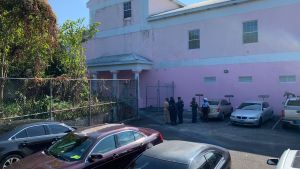
Bankman-Fried reportedly was permitted to take his medication as he requested and bail was being considered.
Bahamas police arrested Bankman-Fried on Tuesday on request by the US government and 8 criminal charges, among others, await him in a New York court. The US Securities Commission has also alleged he defrauded investors out of billions of dollars and led them to believe their monies were safe.
Featured Image of Bahamas Court: Keith Gomez